 Dog Care
 Cat Care
 Small Pets
 Pet Food & Nutrition
 Training & Behavior
 Pet Care & Grooming
 Pet Gear & Supplies
 New Pet Owners
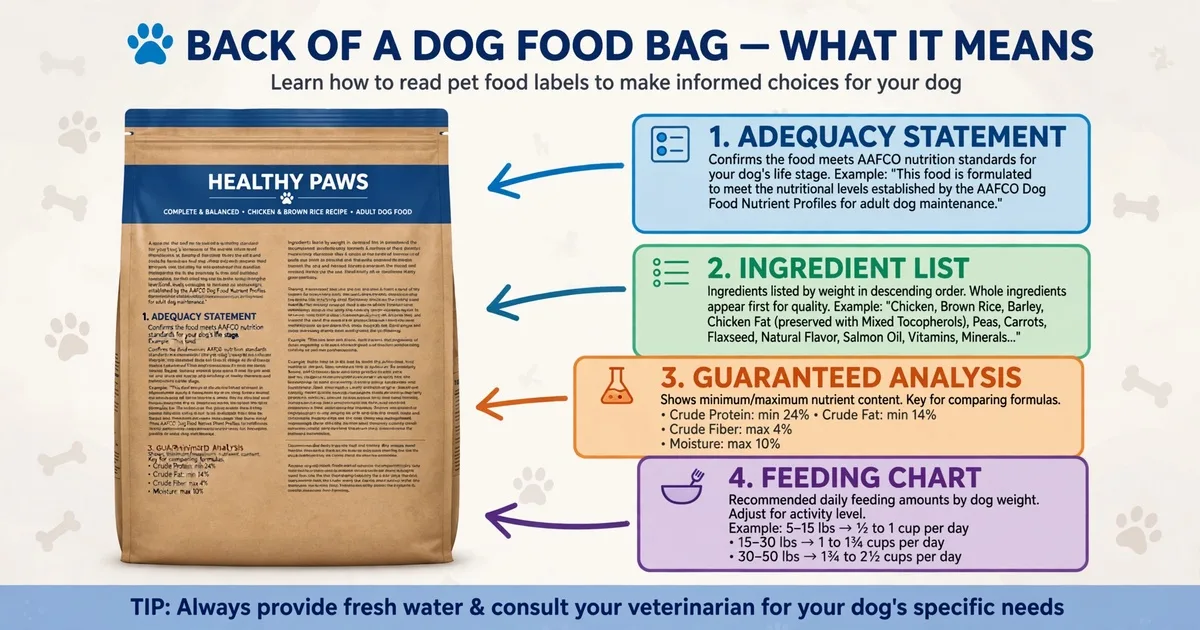
How to Read a Dog Food Label (What Each Part Means)
You’re standing in the pet food aisle holding two bags that both say “natural,” both show a happy dog on the front, and cost very different amounts. The front tells you almost nothing. Learning how to read a dog food label means skipping the marketing and going straight to the back and sides, where the rules are strict and the facts live. This guide walks through every section in the order you should check it, with examples for puppies, adults and seniors.
Quick Answer
- Check the nutritional adequacy statement first. It should say the food is “complete and balanced” for your dog’s life stage.
- Use the ingredient list to see what the food is made of, but remember it’s sorted by weight, including water.
- Use the guaranteed analysis to compare foods, but convert to a dry matter basis if you’re comparing wet and dry.
- Treat the feeding chart as a starting point. Your vet sets the real amount.
Note: This guide follows U.S. labeling conventions (AAFCO model rules and FDA oversight). Rules in Canada, the UK, Australia and the EU differ in details, but the same basic sections appear on most bags.
Start With the Nutritional Adequacy Statement
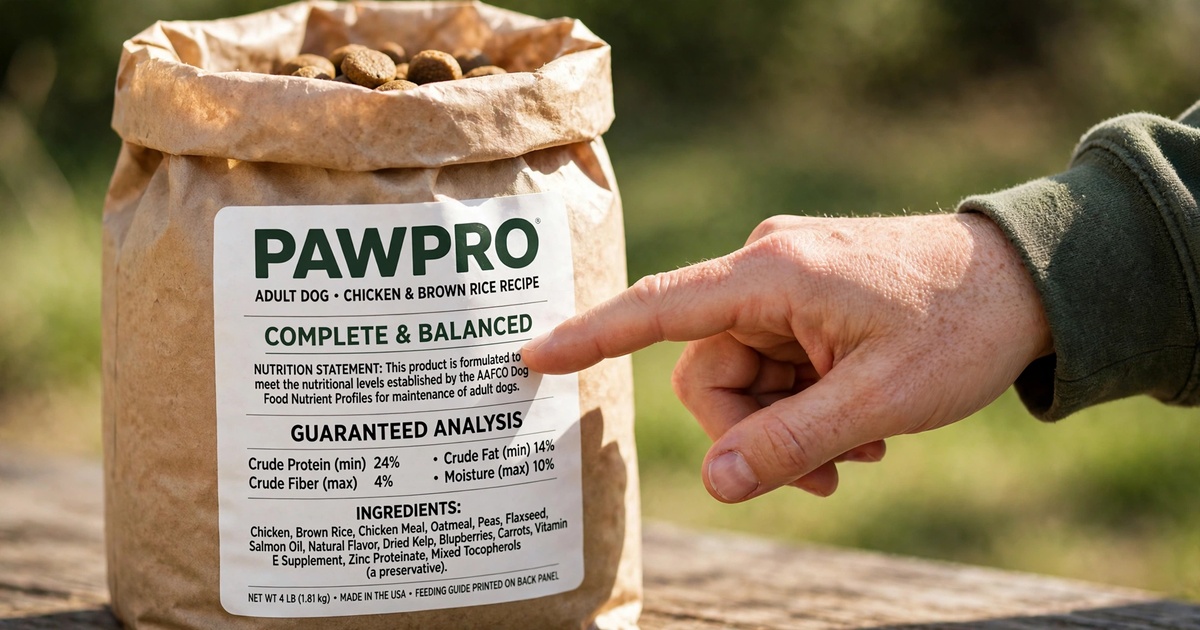
This small block of text, usually near the ingredient list, is the most useful part of the label. It tells you whether the food can be your dog’s main diet.
Look for wording like “formulated to meet the nutritional levels established by AAFCO Dog Food Nutrient Profiles” or “animal feeding tests using AAFCO procedures substantiate that this food provides complete and balanced nutrition.” Then check the life stage:
- Growth (puppy): Needed for puppies and for pregnant or nursing dogs. Large-breed puppies need a food that specifically says it’s appropriate for large-size growth.
- Adult maintenance: Fine for most healthy adult dogs.
- All life stages: Meets the higher puppy requirements, so it works for any age. It can be more calorie-dense than a lazy senior or an indoor small-breed adult needs.
If the label says “intermittent or supplemental feeding only,” it’s a treat or topper, not a meal. Skip it as a main diet.
In the UK and EU, the equivalent wording is “complete” versus “complementary” feed. Only “complete” foods are meant to be fed alone.
Read the Product Name Carefully
The words in a product name follow rules in the U.S., and the amount of the named ingredient changes with the wording.
| Name style | Example wording | What it generally means |
|---|---|---|
| 95% rule | “Chicken Dog Food” | Named ingredient makes up at least 95% of the product (not counting water) |
| 25% rule | “Chicken Dinner,” “Chicken Entrée,” “Chicken Formula” | At least 25%, but less than 95% |
| 3% rule | “Dog Food With Chicken” | At least 3% |
| Flavor rule | “Chicken Flavor” | Only enough to be detectable, possibly none at all |
So “Beef Dinner” and “With Beef” are very different foods, even though both mention beef up front.
Decode the Ingredient List
Ingredients are listed by weight at the time they’re mixed in, heaviest first. That has a few catches.
Water weight skews the order. Fresh chicken is about 70% water, so it weighs a lot going into the mixer but shrinks once the food is cooked. A “meat meal” is already dried, so it can contribute more actual protein than fresh meat sitting in the same spot.
Ingredient splitting can hide the real picture. A label might list “peas, pea protein, pea fiber” separately. Combined, peas might outweigh the first-listed meat. Read the first five to seven ingredients as a group.
Some terms sound worse than they are. “By-products” and “meals” aren’t automatically bad. A named meal (like “chicken meal”) is a concentrated protein source. Vague terms like “meat meal” with no animal named give you less information. A specific name is generally more transparent.
Don’t judge by a single ingredient. Dogs can digest many grains, and there’s no label shortcut that proves a food is better. The FDA has investigated a possible link between certain diets (often grain-free or legume-heavy) and a heart condition in dogs. If you’re thinking about a grain-free food, talk to your vet before switching.
For a scenario: a first-time owner in an apartment picks a bag because “real salmon” is first on the list. That’s a reasonable sign. But the same owner should also check the adequacy statement and the calorie content. A great ingredient list on a food that isn’t complete and balanced for the dog’s life stage is still the wrong food.
Understand the Guaranteed Analysis
This panel lists four numbers. They’re not exact amounts. They’re minimums or maximums:
- Crude protein (minimum)
- Crude fat (minimum)
- Crude fiber (maximum)
- Moisture (maximum)
“Crude” refers to how the nutrient is measured in the lab, not its quality. It tells you how much, not how digestible.
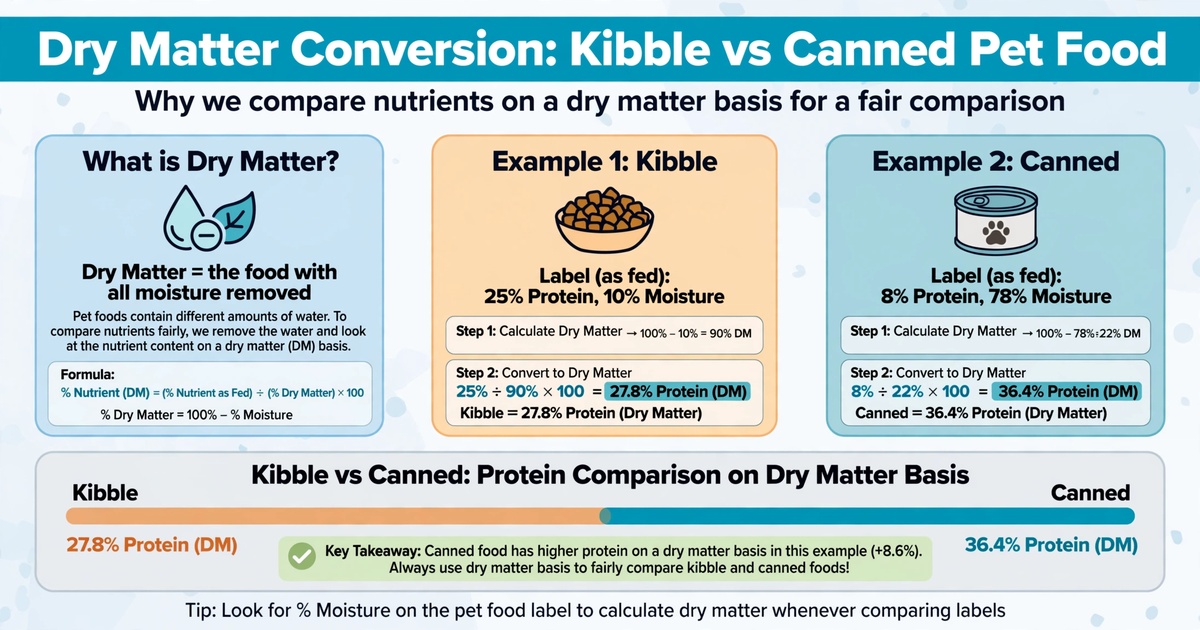
Why comparing wet and dry is tricky. Dry kibble is around 10% moisture, while canned food can be around 75-80%. To compare fairly, convert to dry matter:
- Subtract the moisture percentage from 100 to get the dry matter percentage.
- Divide the nutrient percentage by that dry matter number.
- Multiply by 100.
Here’s an example with made-up numbers:
| Food | Label protein | Moisture | Dry matter protein |
|---|---|---|---|
| Kibble | 25% | 10% | 25 ÷ 90 = about 27.8% |
| Canned | 8% | 78% | 8 ÷ 22 = about 36.4% |
The canned food looks far lower on the label but is actually higher in protein once the water is removed. This doesn’t make it better. It just means the raw label numbers can’t be compared directly.
Check Calories, Not Just Cups
In the U.S., labels list calories as “kcal/kg” and usually “kcal/cup” or “kcal/can.” This is one of the most useful numbers for weight management. Two foods can both say “1 cup” on the feeding chart and differ by 100 calories or more per cup.
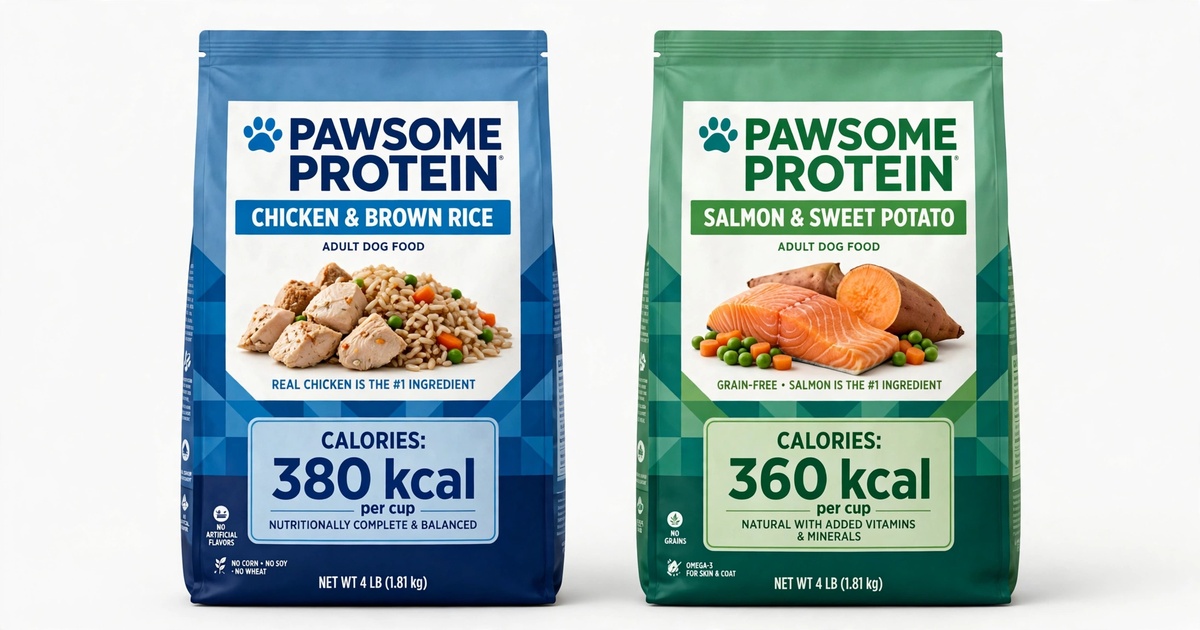
Calorie needs vary a lot by age, size, activity level, spay/neuter status and health. As a rough illustration only, a very active young adult and a 12-year-old couch companion of the same size can need noticeably different amounts. Your vet can give you a daily calorie target, and you can match it to the kcal/cup on the bag.
Use the Feeding Guidelines as a Starting Point
The chart on the bag is built for an average dog. Your dog might need more or less. Start there, then adjust based on your dog’s body condition. You should be able to feel the ribs under a thin layer of fat, and see a waist from above.

Remember that treats, chews, and table scraps count too. A common guideline many vets use is to keep treats to a small portion of daily calories, but ask your vet for the right number for your dog.
Puppies, seniors, pregnant dogs and dogs with health conditions all have different needs, so the chart is only a rough guide for them.
Look at the Manufacturer Information
Find the company name and address, and check the wording:
- “Manufactured by” or “Made by”: The company that owns the label also makes the food.
- “Manufactured for” or “Distributed by”: Another company produces it.
Neither wording is automatically bad. What matters is that there’s a customer service number or website, and that the company can answer questions about its nutrition expertise, quality control, and where ingredients come from. Some owners find it reassuring when a company employs a veterinary nutritionist. The WSAVA (World Small Animal Veterinary Association) publishes questions you can ask any pet food company.
Check the Best-By Date and Storage
Look for a “best by” date and a lot code, and keep the lot code handy in case of a recall. Once a bag is open, fats can go stale. Store food in its original bag, sealed, in a cool, dry place. Many owners put the whole bag inside an airtight container so the lot code stays attached.
Ignore These Front-of-Bag Claims
Some words have little or no regulated meaning on the front of the bag:
- “Premium,” “gourmet,” “holistic”: Marketing terms with no set legal definition in the U.S.
- “Natural”: Has a specific meaning (no artificially made ingredients, with some exceptions), but it says nothing about quality or whether the food suits your dog.
- Pictures of vegetables or whole cuts of meat: Not proof of what’s inside.
Common Mistakes to Avoid
- Choosing by price alone. Expensive doesn’t guarantee suitability, and cheap isn’t automatically bad. The adequacy statement and your dog’s response matter more.
- Switching foods suddenly. Most dogs do better with a gradual change over about a week to ten days, mixing in more of the new food each day. Your vet can suggest a schedule for sensitive dogs.
- Feeding a puppy adult food (or the reverse). Puppies need growth formulas. Overweight adults on “all life stages” foods can gain quickly.
- Ignoring your dog. A food that looks perfect on paper but gives your dog loose stools, itching or low energy isn’t working.
- Assuming a label can diagnose a problem. A label shows what’s in the food. It can’t tell you whether your dog has an allergy or health issue.
When to See a Vet
Talk to your vet before changing foods if your dog has a health condition such as kidney disease, pancreatitis, diabetes, food allergies or a heart problem. Special diets for these conditions are often prescribed, and the right one depends on your dog.
Call your vet if you notice:
- Vomiting or diarrhea that lasts more than a day, or that comes back after a diet change
- Ongoing itching, ear infections or skin problems that might relate to food
- Weight loss or weight gain you can’t explain
- A dog who refuses food for more than a day or so
- Blood in the stool or vomit
Get emergency help immediately if your dog may have eaten something toxic (like chocolate, xylitol, grapes or raisins), is having trouble breathing, collapses, has a seizure, or has a swollen, hard belly with unproductive retching, which can signal bloat. Call your vet or the nearest emergency animal clinic right away.
Home-cooked and raw diets are especially tricky to balance. If you’re considering one, work with your vet or a board-certified veterinary nutritionist.
For more day-to-day basics beyond food, see our guide on how to care for a dog.
FAQ
What is the most important thing on a dog food label?
The nutritional adequacy statement. It tells you whether the food is complete and balanced and for which life stage. Without it, the food may not be meant as a sole diet. After that, look at ingredients and calories to compare options.
Are the first five ingredients the most important?
They make up most of the food by weight, so they’re worth checking, but they’re not the whole story. Water content, ingredient splitting and processing all affect how much of each ingredient is really in the bag. Treat the list as one clue among several.
Is “by-product” bad in dog food?
Not automatically. By-products can include organ meats, which some dogs digest well. The concern is vagueness and quality control, not the word itself. A named source tends to be more transparent. If your dog has health issues, ask your vet which ingredients to avoid.
Does a higher protein percentage mean better dog food?
No. A higher number doesn’t prove better quality or digestibility, and the right amount depends on your dog’s age and health. Compare foods on a dry matter basis, and ask your vet before choosing a high-protein diet, especially for seniors or dogs with kidney concerns.
How do I know how much to feed my dog?
Start with the bag’s feeding chart, then adjust based on your dog’s body condition and your vet’s advice. Check the calories per cup and account for treats. Your vet can set a daily calorie target that fits your dog’s age, size and health.
Is grain-free dog food better?
Not necessarily. Most dogs can digest grains, and true grain allergies are less common than many owners think. The FDA has looked into a possible link between some grain-free diets and heart disease in dogs. Talk to your vet before choosing or switching to one.
Final Thoughts
Check the adequacy statement first, then the ingredients, calories and analysis, and let your dog’s body condition, stool and energy have the final say. If you’re ever unsure, bring the bag to your next vet visit and ask them to walk through it with you.
Join our Telegram to get all the updates.





Comments (0)
Be the first to comment.